Job Skills You Need to Succeed in Today’s Workplace

In today’s competitive job market, having the right professional skills is more important than ever. Employers are not only looking for academic qualifications but also for practical abilities that help you perform effectively at work.
Whether you are a student, a fresh graduate, or a working professional, developing the right job skills can open doors to better opportunities and long-term career success.
Job skills are essential abilities that help individuals perform tasks effectively in the workplace. These skills include both hard skills, such as technical knowledge, and soft skills, like communication and teamwork. Developing strong job skills can improve your performance, increase your chances of getting hired, and support long-term career growth. In today’s competitive environment, continuously improving your job skills is key to achieving success.
1. What Are Job Skills?
Job skills are the abilities and knowledge that allow you to perform tasks effectively in a workplace. These skills can be divided into two main types:
- Hard skills: Technical abilities that can be learned, such as coding, accounting, or using software
- Soft skills: Personal traits and behaviors, such as communication, teamwork, and problem-solving
Both types of skills are essential for career growth.
2. Why Are Job Skills Important?
Developing strong workplace skills can bring many benefits:
- Improve your chances of getting hired
- Help you perform better at work
- Increase your confidence
- Open up promotion opportunities
- Make you more adaptable to change
Without the right job skills, it can be difficult to compete in today’s job market.
3. Top Job Skills You Should Develop
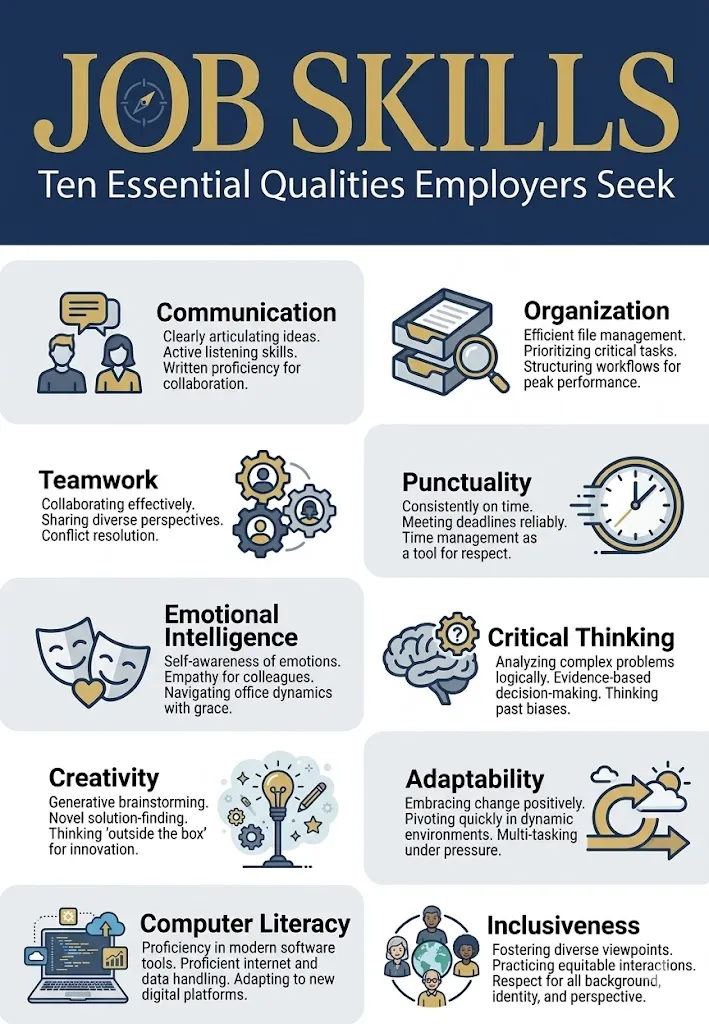
3.1. Communication Skills
Communication is one of the most important skills in any profession. Being able to express your ideas clearly and listen to others effectively helps build strong relationships at work.
You can improve this skill by:
- Practicing speaking and writing regularly
- Listening actively
- Learning how to give and receive feedback
3.2. Time Management Skills
Time management helps you complete tasks efficiently and meet deadlines.
To manage your time better:
- Create daily to-do lists
- Prioritize important tasks
- Avoid distractions
- Use techniques like the Pomodoro method
Good time management is a key professional skill that increases productivity.
3.3. Problem-Solving Skills
Employers value people who can solve problems quickly and effectively.
To improve this skill:
- Analyze situations carefully
- Think critically
- Consider different solutions
- Learn from past mistakes
Strong problem-solving job skills make you more valuable in any workplace.
3.4. Teamwork Skills
Most jobs require working with others. Teamwork skills help you collaborate, share ideas, and achieve common goals.
You can develop teamwork skills by:
- Respecting different opinions
- Supporting your teammates
- Communicating clearly
- Taking responsibility
3.5. Adaptability and Flexibility
The workplace is constantly changing. Being adaptable is one of the most important job skills today.
To become more flexible:
- Be open to new ideas
- Learn new tools and technologies
- Stay positive during change
3.6. Digital Skills
In the digital age, basic technology skills are essential job skills.
Examples include:
- Using Microsoft Office (Word, Excel, PowerPoint)
- Working with online tools
- Basic data analysis
- Understanding digital communication platforms
3.7. Leadership Skills
Even if you are not a manager, leadership is still an important job skill.
Leadership includes:
- Taking initiative
- Making decisions
- Motivating others
- Being responsible
4. How to Improve Your Job Skills

Improving your job skills takes time and effort, but it is completely achievable.
Here are some practical ways:
- Take online courses (Coursera, Udemy, etc.)
- Read books related to your field
- Practice your skills daily
- Ask for feedback from others
- Gain real-world experience through internships or part-time jobs
Consistency is the key to improvement.
5. Conclusion
In conclusion, job skills are the foundation of success in today’s competitive workplace. By developing both hard skills and soft skills, you can improve your performance, increase your confidence, and create more career opportunities. The key is to stay consistent, keep learning, and adapt to changes in the modern work environment. Remember, investing in your job skills today will help you build a stronger, more successful future tomorrow.